Every finding comes with a root cause and a recommendation. Conducted by me, through my experienced and test process.
01
Situational analysis
This is the start of the process and we look at what is your situation. Sending volumes, contact acquisition, bounce history, engagement trends, people, strategies, history of events or problems.
02
Technical & infrastructure review
Next, I review the technical setup mailbox providers use to determine whether emails are trustworthy. Includes everything from SPF, DKIM, DMARC, ARC, DNS, IP, domains, email structure, mailbox providers and potential technical risks and impact on deliverability.
03
Data quality & sending hygiene
What your ESP can't tell you — domain reputation signals, blacklist checks, engagement signals and trends, suppression and throttling indicators, behaviour across Microsoft, Google, Yahoo. This helps identify whether emails may be experiencing filtering or suppression that standard email reporting cannot surface.
03
Reputation & provider response
What your ESP can't tell you — domain reputation signals, blacklist checks, engagement signals and trends, suppression and throttling indicators, behaviour across Microsoft, Google, Yahoo. This helps identify whether emails may be experiencing filtering or suppression that standard email reporting cannot surface.
04
Data quality & sending hygiene
To reduce risk and improve confidence in future sends, we assess the quality of your existing data and current sending practices. Up to 20,000 addresses validated. Provider breakdown mapped and the makeup of your data shapes the entire response.
05
Inbox placement testing
Over a 30-day period, we run continuous inbox placement testing to build an accurate, real-world view of deliverability performance. This allows us to measure your iInbox placement rate, spam placement rate, provider-specific behaviour, reputation fluctuations over timeand signs of filtering or suppression.
06
Diagnosis & action plan
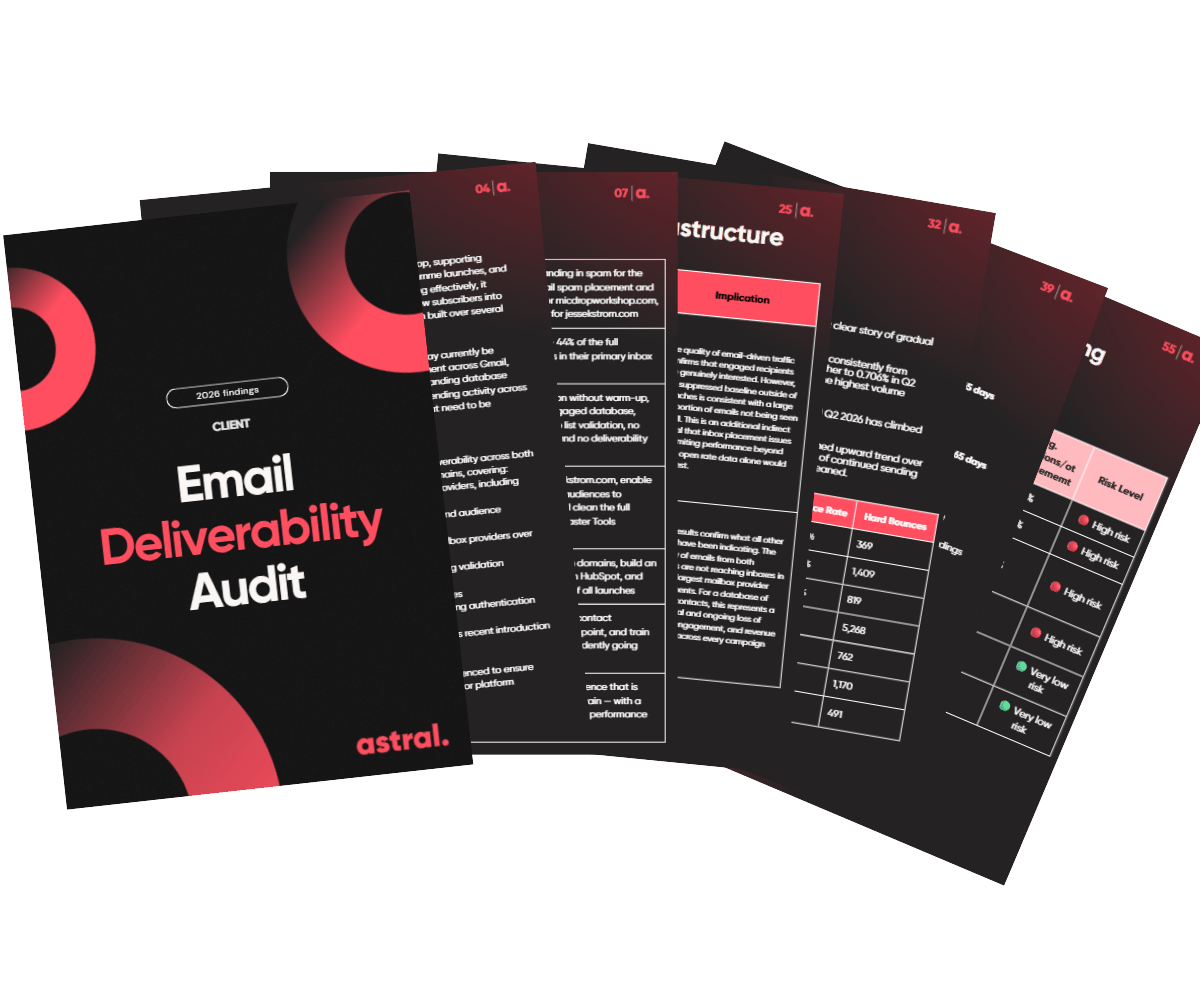
As part of your report, you'll have a clear view of what's happening, why, and what to do (action plan, roadmap and tasks you need to do) — in priority order. We'll do a live walk-through together and any serious issues flagged immediately, not at day 30.
Your audit will give you evidence of exactly what is happening, why and what you need to do to prevent, protect and transform your email deliverability.
Deliverability metrics
Inbox & spam placement rates across Microsoft, Google, Yahoo and other providers.
Clear diagnosis
You'll know what happening, how bad the issue is and why it happened - so you can explain it to stakeholders.
Risk & quality
Full risk and quality profile of your database, practices and approaches.
Practical action plan
Prioritised, easy-to-understand action plan to implement immediately.
Benchmarks to track
Now you have your deliverability benchmarks to track performance going forward.
Live walk through
I'll sit with you and your team to go through the audit findings, answer all your questions and help you understand what you need to do next.
For teams who want to go further, not just receive the findings, but understand them deeply enough to own what comes next. In-person or online, one full day together where I train you on how to audit deliverability going forward, how to interpret the findings and redemption strategies.
Detailed walkthrough of every finding
Expert training on how to test deliverability and interpret findings
Not sure if you need an audit? Fill in the form and I can advise
Can't I just use a deliverability tool?
Tools give a snapshot, one reading, one methodology. This audit runs 30 days across multiple tools and providers. More importantly: tools surface symptoms. The audit finds causes, and gives you a plan to fix them.
We don't have a major problem - do we still need this?
Not necessarily. If there are no warning signs and you're not scaling significantly, it may not be the right call right now. But if any of the seven signs sounded familiar — even slightly — it's worth a conversation. Early intervention is significantly cheaper than recovery.It's also a great preventative tool to have!
Why does this take 30 days? Can it be faster?
A single test can catch a good day or a bad day. Running continuously over 30 days identifies real patterns and distinguishes temporary suppression from structural problems. Compressing the timeline compromises the quality of the findings.
What if you find something serious mid-audit?
I flag it immediately and recommend action — whether that's priming, throttling, or suppression strategies. The audit is always live, not retrospective.
How much does this cost?
Scoped individually depends on the size of your database and the complexity of your setup. The right answer starts with a conversation. I'll give you an honest picture of what's involved and what it costs.
What do we do after the audit?
That depends on your findings and your team's capacity. Some teams take the action plan and implement it themselves — everything in the audit is built for that. Others add the training and workshop or want continued support through my consultative services. Nothing ongoing is obligatory an the audit is made so you are likely to not need it!
What happens next is up to you
Some teams take the action plan and run with it. Others want continued support. Both are completely valid, the audit gives you everything you need to move forward independently.
→ Strategy & advisory — ongoing input across email, CRM, and communication strategy
→ Workshops & upskilling — follow-up training and team development
→ Fractional consultancy — hands-on regular sessions as an extension of the team
Want to learn to do this yourself?
The Deliverability Certification Programme teaches the full six-step audit methodology as a self-paced online course, for teams with the time and capacity to build long-term internal capability.

















.jpeg?width=2000&height=2000&name=91f5d2daa223477fa2ab361b030e7dbc%20(1).jpeg "91f5d2daa223477fa2ab361b030e7dbc (1)")