

Nobody randomly appears on your email list (unless you bought the list or scraped the list *tut tut*).
To get there, somebody had to take an action AND trust you with something.
Maybe they bought a product, they downloaded, they registered, they signed up for your newsletter specifically. At some point they decided you were worth handing over access to the most personal space they own online, and they did it voluntarily, knowing you would use it.
That is a conversion. A significant one!! It is simply not the conversion anybody counts.
I call it the conversion to trust, and I think it is the most under-measured event in marketing.
It has a rate you can calculate, a strength that varies enormously depending on how somebody arrived, and a decay curve that starts the moment they subscribe. Understand all three and a great deal of what looks mysterious about email performance stops being mysterious.
So: the long version. What it is, how to score it, how it decays, how to slow the decay, and how trust turns into revenue at the other end.
The concept
What a conversion to trust is, and why it counts as a conversion
A conversion to trust is the moment somebody grants you access to their inbox. Not the moment they hear of you, not the moment they like you, and not the moment they buy. The moment they let you into their very personal space, which could be their work inbox or personal inbox.
It qualifies as a conversion on every definition we use everywhere else in marketing. There is a decision, there is a cost and value exchange to the person making it, there is an identifiable point at which it happened, and there is a measurable outcome. We just never treated it as one, because it produces no revenue on the day and marketing measures what produces revenue on the day.
This is a BIG deal:
-
A follow costs nothing. It happens inside a feed; it can be undone silently without anyone knowing, and the person gives up no access. The platform stays standing between you and them, deciding whether you get seen.
-
A subscription costs access. Somebody hands you a direct line into the space they use to run their job or their life. No algorithm in between. You can reach them whenever you decide to, which is an extraordinary thing to be given and a slightly alarming one to think about properly.
Which makes your list a trust asset rather than a distribution list, and it makes every email you send a small deposit or withdrawal against it.
And something always happened first
Nobody hands inbox access to a stranger. Before that moment, there was recognition, an association, a tie in their head to your brand or to you. They read something and liked it. They watched a talk. Somebody they trust mentioned you. They saw an ad that hit their emotions and their pain points so they bought.
So the conversion to trust is the visible output of awareness work you probably never measured, and it is the closest thing email has to proof that the awareness worked at all.
It is also why cold email cannot produce one. There is no prior relationship for trust to attach to, nothing was converted, and you did not earn the access. You took it.
%20(1).png?width=1200&height=800&name=Email%20health%20check%20(1200%20x%20800%20px)%20(1).png)
Free Email Marketing Health Check
Audit your entire ecosystem in under 30 minutes
Answer a set of straightforward questions across every area of email marketing and get a personalised score, traffic-light priorities, and clear actions and improvements you can make today.
Trusting your business or brand is NOT the same as trusting your emails
A distinction that catches almost everybody, and it explains one of the most common complaints I hear, which is that customers do not engage with our email.
Somebody who has spent four hundred pounds with you has demonstrated serious trust in your business.
They believed you would deliver; they handed over payment details, and they were right to. That is a substantial trust event or conversion to trust.
It is not the same as trusting you with their inbox.
Purchase trust says I believe you will send me the right product and I believe IN the product and I know what it will help with me with and how my life/work/thing transforms with it.
Inbox trust says I believe you will send me things worth reading, at a frequency I can live with, about subjects I care about. Two different promises, and buying one does not grant you the other.
Which is why a transactional opt-in sits in an interesting middle position. It carries real trust, and that trust was granted for something else. Businesses that treat every purchaser as a fully consented newsletter subscriber are spending credit they were never given, and their complaint rates show it.
The scale
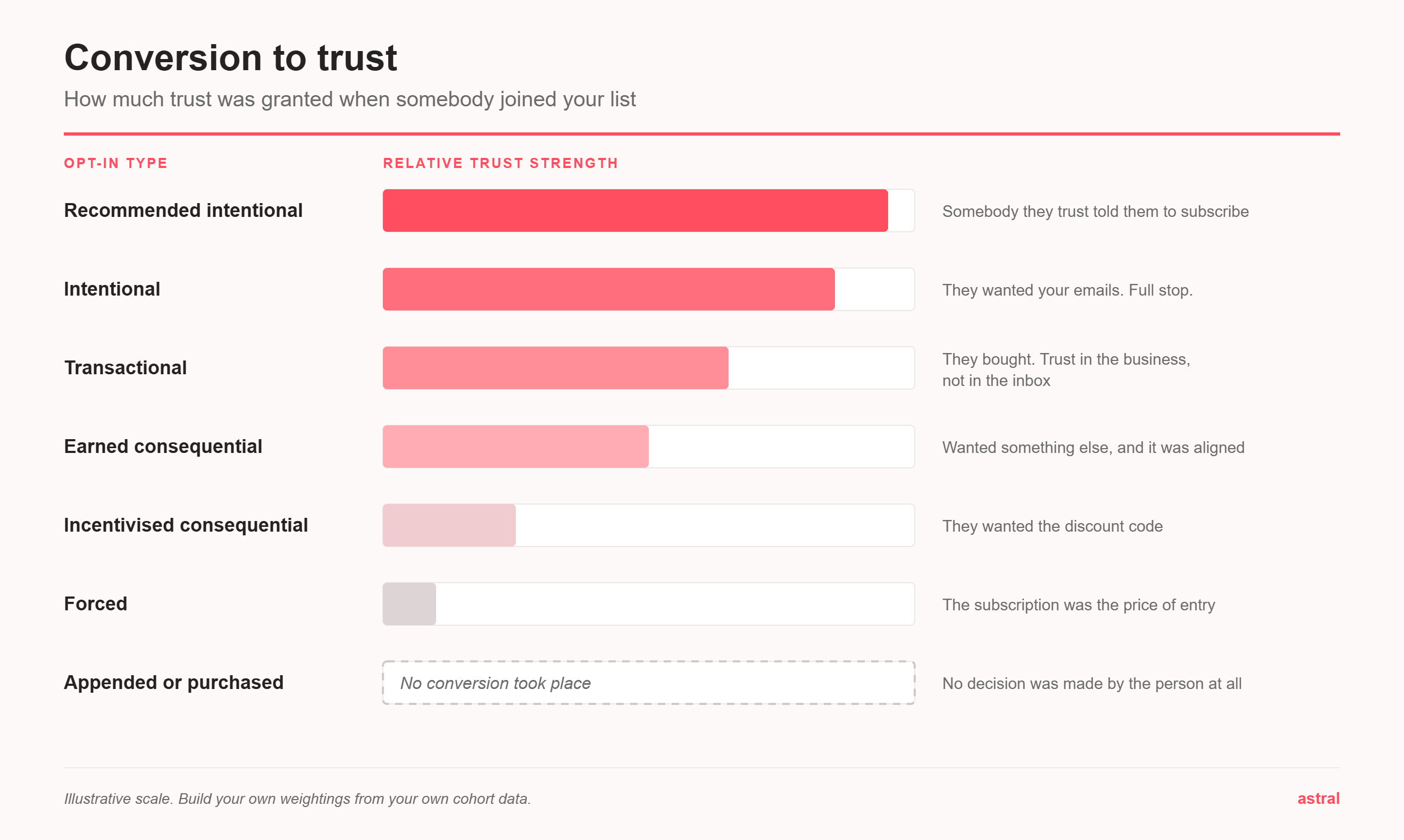
Conversion to trust strength, from highest to lowest
Not all conversions to trust are equal, and the gap between the top and the bottom of this scale is enormous. Where somebody enters determines almost everything about what happens next.
Strength at conversion predicts almost everything downstream
The reason this is worth measuring rather than simply thinking about is that strength at the point of conversion is a leading indicator for the whole relationship.
-
First email engagement. A high-strength conversion produces somebody going to their inbox to retrieve what they asked for. A forced one produces somebody who never wanted the email in the first place.
-
Long-term engagement. The curve is set at entry. People rarely become more engaged than they were in their first fortnight.
-
Complaint likelihood. Forced and incentivised opt-ins generate complaints at rates that will surprise you, because feeling obliged to join produces resentment that sits there waiting.
-
Rate of decay. Covered below, and it is the part people miss entirely.
-
Deliverability, for everybody else on your list. Providers judge you in aggregate, so a large block of low-strength subscribers drags placement down for the high-strength ones.
-
Lifetime value. Which is the one that gets budget, and the one nobody connects back to an opt-in mechanism chosen three years ago by somebody who has since left.
The portfolio
What proportion of your list trusts you?
The exercise I would run on any list, and it takes an afternoon.
-
Tag every entry point with an opt-in type. Every form, every checkout, every pop-up, every import, every event registration. Map them onto the seven levels above.
-
Assign each level a weight. A simple scale works. Recommended intentional at 100 down to purchased at zero, with the levels in between spaced to reflect how differently they behave in your data.
-
Score every contact by how they arrived. One property on the record, set at the point of entry, never overwritten. Historic contacts get scored by best available evidence and flagged as estimated.
-
Produce the portfolio view. What percentage of your list is high trust, medium, low and zero. One chart, and it will change the conversation in your business more than any campaign report you have ever produced.
Most businesses running this for the first time discover that the majority of their list sits in the bottom half of the scale, and that the top of the scale produces the overwhelming majority of the revenue. Which is unsettling and extremely useful, because it tells you exactly where to spend your acquisition effort.
The decay
Trust has a half-life, and it starts running immediately
The part I find most interesting, and the part that makes this a model rather than a classification.
Trust is not a permanent state. From the moment somebody subscribes, it begins to decay, and it will keep decaying unless something reinforces it. Nothing has to go wrong for this to happen. It is the default.
And the rate of decay is not constant across the scale. Strong conversions decay slowly. Weak ones fall off a cliff. Which means a forced opt-in is not simply worth less on day one, it is worth close to nothing by month three, while an intentional one is still carrying most of its value two years later.
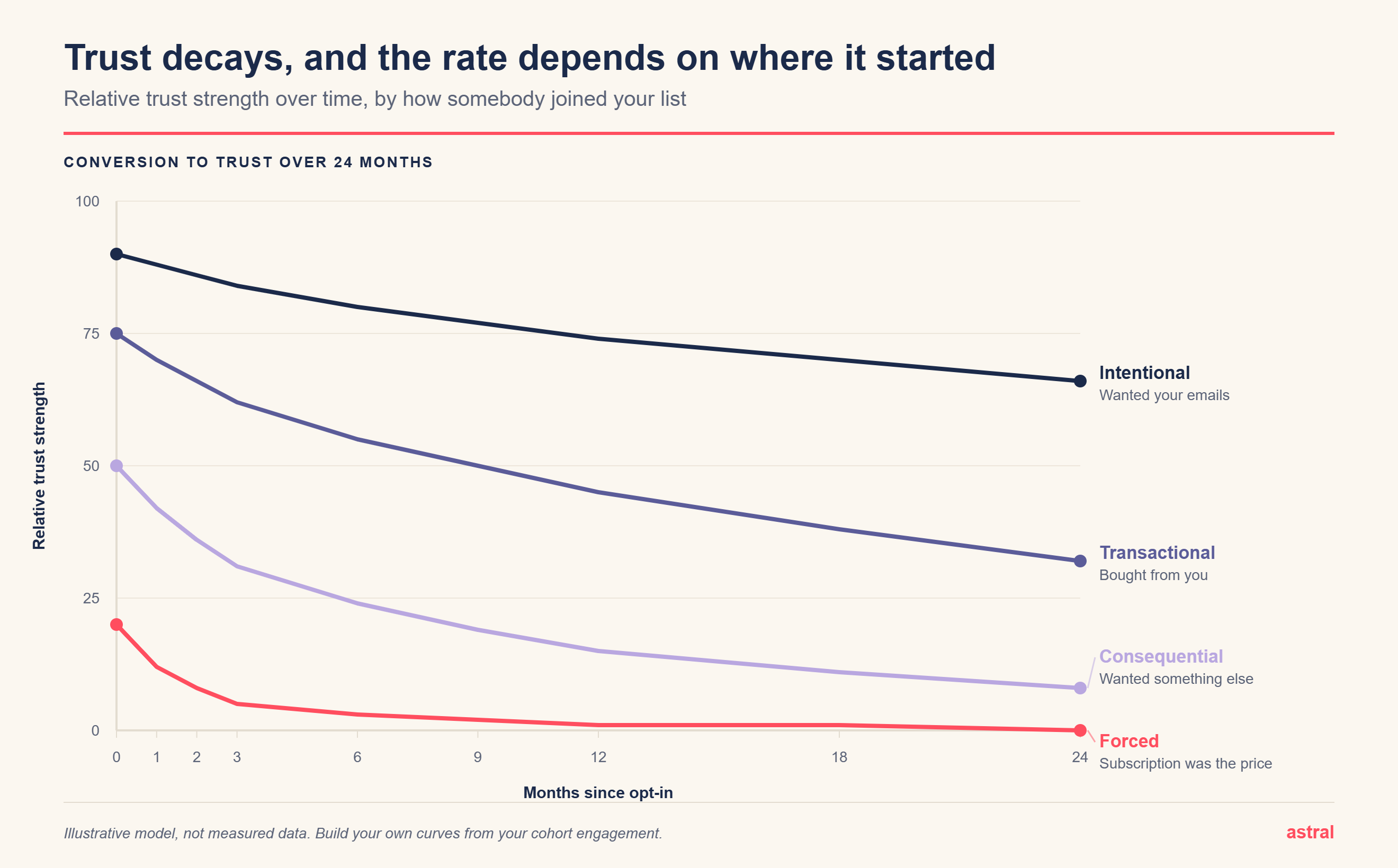
Worth saying plainly that the curves above are an illustrative model rather than measured research. The shape is what matters, and you can build your own version from your own cohort data, which is the exercise I would rather you did anyway.
What accelerates the decay
-
Asking more than you give. Every ask is a small withdrawal. A programme that asks more often than it gives is drawing down the balance every week.
-
Irrelevance. Content that has nothing to do with why somebody subscribed teaches them that the promise was not real.
-
Silence. Memory decays, associations fade, and after a long enough gap people believe they unsubscribed. Going quiet is not neutral.
-
Broken promises. Negative events carry more weight than equivalent positive ones, so one unfulfilled expectation costs more than several fulfilled ones.
-
Frequency without consequence. Habituation. Repetition of a signal that never matters trains people to stop noticing you, and it does so automatically.
-
Friction. A hidden unsubscribe, a preference centre that will not let you leave, a reply address nobody monitors. All of it reads as a business that does not respect the access it was given.
What slows or reverses it
-
Delivering the promise, immediately and completely. The single biggest reinforcement available, and it happens in the first email.
-
Meaningful action by them. Every open, click, reply, purchase or attendance is the person reaffirming the decision. Which is why engagement is not only a measurement, it is a mechanism.
-
Consistency. Predictable, recognisable arrival keeps the memory link warm and the association intact.
-
Giving before asking, repeatedly. Reciprocity is not a trick, it is a well-documented human norm, and the obligation it creates accumulates.
-
Control. Letting somebody choose frequency or topic is a deposit, because it signals that you consider the access conditional rather than owned.
-
Being right about something that mattered. The strongest reinforcement of all, and the hardest to schedule. An email that helped somebody resets the curve.
The measurement
Three numbers, and none of them are open rate
One: conversion to trust rate
Of the people who could have subscribed through a given route, what proportion did? A source-level conversion rate, calculated exactly as you would for any other conversion event.
-
By source, never blended. Blending your pop-up with your newsletter signup produces a number that describes neither.
-
Against a real denominator. Visitors to the page, attendees at the event, people who saw the form. A rate without a denominator is a volume count wearing a percentage sign.
Two: conversion to trust strength
The weighted score from the portfolio exercise above, reported as a distribution rather than an average, because an average hides the shape entirely.
-
Report the mix. What percentage high, medium, low, zero. That mix is your list quality in a single line and it is far more useful than list size.
-
Track it over time. A list that is growing while the mix deteriorates is a list getting worse and bigger at the same time, which is the most expensive combination available.
Three: trust decay
Measured as cohort curves rather than as a snapshot, because decay is a shape rather than a number.
-
Group people by joining month and by opt-in type. Then plot engagement over the following twenty four months.
-
Look for the half-life. How long does it take for a cohort to fall to half its initial engagement? Compare that figure across opt-in types and you have quantified the whole argument in one number.
-
Watch for cliffs. A sharp drop at a specific point usually means a specific cause. A particular email, a frequency change, a promise that stopped being kept.
Improving it
How to increase the rate
-
Be visible before you ask. Conversion to trust is downstream of awareness. People subscribe to senders they already recognise, so the fastest way to improve the rate is usually to improve how often the right people encounter you first.
-
Reduce the perceived cost. Say what they get, how often, and how easily they can stop. Uncertainty is the main thing standing between somebody and a signup, and it costs nothing to remove.
-
Ask at the moment of highest interest. Somebody three quarters of the way through a useful article is a completely different prospect from somebody who arrived four seconds ago and got a pop-up in the face.
-
Use borrowed trust where you can. Recommendations, referrals, being mentioned by somebody credible. It is the highest-strength mechanism on the scale and almost nobody builds for it deliberately.
-
Make the offer about the inbox relationship. A course delivered by email, an assessment with results sent through, a weekly thing with a name and a promise. When the emails ARE the product, the conversion is intentional by construction.
How to increase the strength
-
Separate access from subscription. Give them the thing, then offer the list as a distinct and optional choice. Fewer signups, dramatically higher strength, and no forced opt-in problem to unpick in two years.
-
Make the promise explicit and narrow. What it is, how often, from whom. Satisfaction is a comparison between expectation and reality, so the promise is the denominator for everything that follows.
-
Put a person on it. A name, a voice, a reply address that reaches somebody. Trust attaches to people more readily than to logos.
-
Never bundle consent into something else. Beyond the regulatory risk, a bundled consent is a forced opt-in with better manners, and it behaves exactly like one in your data.
-
Treat purchasers as purchasers, not as subscribers. Earn the inbox permission separately, with an orientation flow that acknowledges how they arrived and makes the case for staying.
The commercial bit
How trust turns into revenue
The question everybody asks at this point, usually with a slightly sceptical tone, and the answer is a chain rather than a leap.
-
Trust granted gives you access. The conversion to trust puts you in a space where you can reach somebody directly, repeatedly, without paying for the privilege each time.
-
Access plus consistency builds recognition. Repeated exposure improves attitude even without conscious attention, which is why the unopened email is still doing work.
-
Recognition plus relevance earns attention when it matters. A recognised sender who has been useful before gets opened on the day somebody has a problem you solve.
-
Attention plus accumulated association makes you the one they think of. Not remembered generally. Linked specifically to the situation that creates the need.
-
Being thought of at the moment of need produces consideration. Which is the actual commercial event, and the only one that email can reliably cause.
-
Consideration plus low friction produces revenue. The ask converts, and it converts at a rate determined by everything in the five steps above it.
The insight I would leave you with
Your conversion rate on the ask is your trust score, made visible.
Send the identical email, with the identical offer, to two lists of the same size in the same industry, and you will get wildly different results. Not because one email was better. Because one audience had accumulated more trust than the other, and the ask simply cashed in what was already there.
Which is why what is a good conversion rate is an unanswerable question, and why the businesses obsessing over their call to action button are optimising the last two percent of a process that was decided months earlier.
Revenue is a lagging indicator of trust. If you want more revenue from email, the lever is not the ask. It is everything that happens before the ask, and the conversion to trust is where all of it starts.
The conclusion
Somebody trusted you enough to let you into the place where they run their job or their life. Thousands of somebodies, probably, most of them years ago, and almost none of it is recorded anywhere in your business as an achievement.
Start counting it. How many people converted to trust this month, through which routes, at what strength, and how much of the trust you already hold is still intact.
Then protect it, because it decays whether or not you are paying attention, and every business I have ever audited was spending it considerably faster than it was earning it.