

Let's start with the caveat, because it matters. With that said — generational patterns in inbox...
A few years ago I attended MailChimp's conference and heard a speaker talk about something that shifted how I think about email fundamentally. He wasn't talking about deliverability or open rates or any of the usual stuff. He was talking about impressions. About how email, like a billboard on a motorway, does something to the human brain even when you do not consciously engage with it.
I have been sitting with that idea ever since, testing it, watching it play out across thousands of programmes, and developing my own framework around it. And what I am about to tell you in this blog goes against almost everything that gets said about email online.
Some of your most commercially valuable email activity is happening right now, in emails that nobody is opening or clicking. And if you are suppressing people based on engagement data alone, you are probably cutting off a relationship that is doing more quiet work than you can see.
But first, we need to talk about a statistic that has been misleading the entire industry for years.
The £42 for every £1 spent — let's actually look at that
You have seen it everywhere. It is probably in a slide deck somewhere in your organisation. Email marketing delivers £42 return for every £1 spent. The highest ROI of any marketing channel. Proof that email is the most powerful tool in your arsenal.
I want to be really honest about this statistic, because I think it has done a lot of damage to how we think about and measure email.
That figure came from the Data and Marketing Association. It was published in May 2019. And when you actually look underneath it, several things become clear:
-
It was self-reported ROI from an online survey
-
The sample size was 197 marketers in the UK
-
It was described as a rise from the previous year — not a fixed benchmark
-
It is one figure, from one study, from one country, from six years ago
Self-reported ROI from 197 people is not a universal truth about email marketing. It is a snapshot of what a small group of marketers in a specific moment believed their email was delivering. And yet it has been cited as fact, globally, for half a decade.
I am not saying email does not generate significant commercial value. It absolutely does — and I have seen it do extraordinary things for businesses across every sector. But the way that value works is not what the £42 figure implies. Email is not a direct, transactional, click-to-convert machine that you can point at revenue and attribute neatly. That is not what it is. That is not how it works. And trying to measure it that way is why so many marketing teams are either overclaiming its impact or dismissing it entirely.
The real story of how email generates value is much more interesting — and much harder to see in a dashboard.
We have been trying to make fetch happen
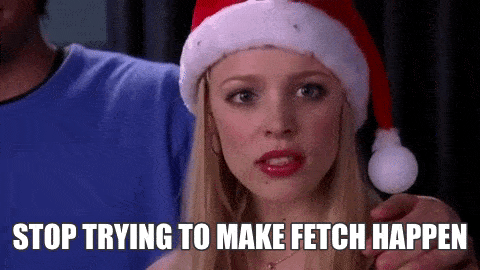
In Mean Girls, there is a running joke where someone keeps trying to make "fetch" happen — trying to force a thing to be what it is not. That is exactly what we have been doing with email performance.
We have been taught — by ESPs, by marketing content, by the metrics our dashboards show us — that opens and clicks are the whole story. That an email campaign succeeds when people open it, click it, and convert. And everything that does not follow that path is failure.
So we build emails designed to maximise opens. We write subject lines for clicks. We suppress people who have not opened in 90 days. We A/B test subject line phrasing to chase tenths of a percentage point. And then we report these numbers as evidence of whether email is working.
But this entire framework is built on a misunderstanding of how the inbox actually works — and how human brains actually process the information they encounter there.
The inbox is not a click-generating environment. It never was. It is a utility environment. A task space. A place people go to check, retrieve, clear, and manage. The vast majority of the time, nobody opens their inbox hoping to be sold something or hoping to take an action on a brand email. They open it because it is a habit, or because they need something specific.
And within that context — that task-focused, habit-driven, utility environment — something else is happening. Something that does not register in any standard reporting. Something that has been generating commercial value quietly, consistently, without a single click.
The billboard effect
Physical billboards do not require interaction to work.
You drive past a billboard, you do not consciously decide to read it, you do not engage with it, you do not click anything. But your brain sees it — and your brain processes it. The brand name registers and whatever association that brand carries with it gets reinforced or established. All of this happens passively, subconsciously, without any deliberate effort on your part.
The same thing happens in the inbox.
When you scroll through your emails — whether you are on your phone in the morning, clearing your inbox before a meeting, triaging what needs attention — your eyes move across the sender names and subject lines. You do not consciously process all of them. You do not stop and read each one. But your brain is doing something. It is registering. It is building associations. It is reinforcing patterns.
The sender name is seen. The subject line is absorbed, even briefly. The brand is registered — positively, negatively, or neutrally — and that registration is building something over time.
This is what the speaker at the MailChimp conference was talking about when he talked about impressions. Each email that lands in someone's inbox — regardless of whether it is opened or clicked — is an impression. And impressions accumulate.
Over forty impressions across six months, a brand that someone has never consciously engaged with can feel familiar. Can feel like something they know. Can have built enough ambient presence that when the moment of need arrives, they think of that brand first — without being able to trace exactly why.
The test that proves it — and that everyone should run
Here is the test I recommend for anyone who wants to understand the billboard effect in their own programme.
Take your database. Split it into two equal samples with the same audience makeup — same mix of customers, leads, and warm contacts. Call them Pot A and Pot B. Keep emailing Pot A everything you would normally send. Stop emailing Pot B entirely.
Run that for a meaningful period — at least three to six months. Then look at the commercial outcomes: revenue, retention, leads, pipeline, conversions. Whatever your business measures.
Every single time I have run or observed this test, Pot B shows a decrease in commercial value. Sometimes small. Sometimes more significant. But consistently, predictably, the pot that stops receiving emails loses something — even if it was not opening or clicking the emails it was receiving.
Now here is where it gets more interesting.
Take the non-openers from Pot A. The people who, by all standard metrics, are completely disengaged. Have not opened anything in six months or more. Would be suppressed by most engagement-based rules. But crucially — they are a warm audience. They took some action at some point. They are customers, or they signed up intentionally, or they showed real intent at some stage in their journey.
Split that group. Keep emailing half. Stop emailing the other half.
Again, consistently, the group that keeps receiving emails — even emails they never open — maintains slightly higher commercial value. They convert more. They return more. They refer more. The brand is staying present in a way that matters, even without a single click to show for it.
How humans actually behave in the inbox — what I have seen
One of the most valuable research exercises I have ever done is watching real humans interact with their own inboxes. Not simulated environments. Not surveys. Real people, their actual inboxes, their phones and computers, their real habits.
What you see when you do this changes how you think about email permanently.
People scroll through their inbox the same way they scroll through anything. Their eyes move fast. They are not reading every subject line — they are scanning. Making micro-decisions in milliseconds about what requires attention and what does not. The vast majority of what they pass over is registered by the brain at some level, even without conscious processing.
The checking behaviour is particularly interesting. In personal inboxes, most people check not because they are expecting something specific, but out of habit. It is a version of the same neurological loop that makes us check social media — a pattern of behaviour that the brain has automated because it was rewarded at some point. The inbox checking habit is rooted in years of retrieving things that mattered: confirmations, documents, replies. Even when checking becomes habitual rather than purposeful, the inbox visit still exposes the brain to everything that is sitting in that list.
In B2B, the inbox is a working environment. An extended to-do list. A place where professional decisions are managed and stakeholder relationships are maintained. The checking behaviour here is more deliberate, but the scanning behaviour within the inbox is similarly rapid. Subject lines are assessed in fractions of a second.
In both contexts — consumer and professional — the brand associations being built through repeated exposure are real. They are just invisible in the data.
The inbox versus social media — an important comparison
Social media and email are often compared as though they are equivalent attention environments. They are not.
Social media is designed to actively capture attention. The content moves, it makes noise, it uses every available psychological mechanism to hook you in. You go to social media and it does something to pull you deeper.
The inbox is different. Nobody is being pulled deeper into the inbox. The inbox is a utility environment. The content does not move. It does not make noise. What it does is sit there, consistently, over time, building presence.
This is actually an advantage, not a limitation. The inbox relationship is one that the subscriber chose to enter — at least in principle. The brand is there with permission. And that permission-based, consistent presence is what creates the ambient trust that social media cannot replicate in the same way.
The brand recall mechanism — why familiarity breeds preference
There is a well-documented psychological phenomenon called the mere exposure effect. Simply put: familiarity creates preference. The more often we are exposed to something — even passively, even without conscious engagement — the more positively we tend to view it.
This is why advertising works at scale. It is why brand-building campaigns that do not directly ask for anything still generate commercial return over time. It is why the brand whose name you have seen forty times in six months feels like a safer choice than the brand you have never heard of, even if you cannot explain why.
In email, this plays out like this. A subscriber who has received your newsletter for eight months without opening it has still seen your sender name eighty times. They have seen snippets of your subject lines. Their brain has built an association between your name and whatever subject matter you consistently communicate about.
That association is not nothing. When a colleague mentions they need what you offer, your name comes to mind. When they search for the category you operate in, you feel familiar. When a peer recommends you, the warmth of that recommendation is amplified because you are not a stranger — you are someone they have already been exposed to, repeatedly, even without realising it.
This is why subject matter association is one of the most important strategic decisions in email. What do you want people to think of when they see your sender name? Not what do you want them to click — what do you want them to associate with you?
When people think of my name, I want them to think: email strategy, CRM, HubSpot. Not because I tell them that every time. Because every email I send reinforces those associations, whether they open it or not. The subject lines I write, the topics I cover, the positioning in the preheader — all of it is building a word association in the background, consistently, over time.
%20(1).png?width=1200&height=800&name=Email%20health%20check%20(1200%20x%20800%20px)%20(1).png)
Free Email Marketing Health Check
Audit your entire ecosystem in under 30 minutes
Answer a set of honest questions across every area of email marketing and get a personalised score, traffic-light priorities, and clear actions and improvements you can make today.
The Wagamama effect — and why I nearly missed it
I have to tell you about this because it is the best real-world example I have of the billboard effect in action, and it happened to me.
Wagamama does not send many emails. They have a genuinely thoughtful email strategy — they only send when they have something actually worth saying. And they do the pre-open package well.
One day I received a Wagamama email. I did not open it. I did not need to. The subject line said "new chicken bao buns" and the preheader described them. That was enough. Everything I needed to know was in the pre-open. I made a decision — I wanted to try these — and I did not need to open the email to get there.
But here is what happened next. Because I had made the mental note and the email had done its job, I deleted it. Processed, done, out of the inbox. Then I texted my partner, mentioned the chicken bao buns, did a quick Google to see what they looked like, and two weeks later on a Friday we went.
From Gmail's perspective: I deleted the email without opening it. That is a negative signal. Wagamama's emails started going to my spam. I had to retrieve them and move them back because I actually love getting their emails — I just process them very efficiently.
Now think about what happened here. That email generated a restaurant visit, a conversation, a Google search, and word-of-mouth recommendation to my partner. None of that is visible in Wagamama's email analytics. The email looks like a complete failure — deleted without an open. It was one of the most effective emails they could have sent me.
This is the Wagamama effect. The email did exactly what it was supposed to do — it delivered the value of the message in the pre-open, without requiring a click or even an open. And the commercial outcome happened entirely outside the email attribution window.
What this looks like across different business types
The billboard effect plays out differently depending on the business model and the audience, but the underlying mechanism is consistent.
John, meaningful actions, and why your disengagement strategy might be wrong
Take John. John signed up for my newsletter over a year ago. He has not opened a single newsletter in the last six months — not one that my tracking can see. By standard re-engagement logic, John should have been through a win-back campaign and probably suppressed by now.
But here is what John is actually doing. He visits my blog once a week. He signed up to a webinar last month. He has been reading my content, just not through email. John is not disengaged from my brand. John is disengaged from email as the specific channel. Those are completely different things.
If I had suppressed John six months ago, I would have removed a genuinely warm prospect from my programme at exactly the moment he was getting closer to a decision. The email was doing something for John — maintaining presence, reinforcing my positioning in his mind — even in the periods when he was not interacting with it directly.
The question is not whether John opens my emails. The question is: does John have any other meaningful interactions with my brand? And if the answer is yes — website visits, content downloads, event registrations, product page visits, pricing page views, anything that signals genuine ongoing engagement with the brand — then John is not disengaged. He is just not an email-opener.
Meaningful actions are the things that tell you a person is genuinely alive in their relationship with your brand. An open is not a meaningful action. A click is borderline, depending on what was clicked. But a pricing page visit, a blog read, a content download, a webinar registration, a direct purchase, a reply to an email — these are meaningful actions. They tell you something real.
Before you suppress anyone based on email engagement alone, ask: what other signals does this person have? If the answer is none — no website activity, no purchase history, no event attendance, nothing — then yes, stopping email makes sense. But if there are other signals, you may be cutting a relationship that is quietly compounding.
The billboard effect works for you or against you — there is no neutral
Here is the part that most people miss when they think about the billboard effect.
This mechanism does not just generate positive associations. It also generates negative ones.
You know that brand in your inbox that only ever sends promotional emails. Every subject line is a sale, a last chance, a percentage off, a countdown. You have never unsubscribed — you never got around to it — but you have trained your brain to associate that sender name with noise. With low-value, high-frequency pushing. With the feeling of being treated as a wallet rather than a person.
When their email appears in your inbox, you barely register it. And when you do, the association it reinforces is negative. That is the billboard effect working against them. Every email they send to you is building a story, and the story is: this brand does not respect my inbox.
This is why the association you build matters as much as the presence itself. If you are showing up consistently with something that says interesting things about valuable topics, the accumulated impression over time is: this brand knows what they are talking about. If you are showing up consistently with discount codes and urgency, the accumulated impression is: this brand just wants me to buy something.
The pre-open package — sender name, subject line, preheader — is your entire billboard. Everything the non-opener sees is in those three elements. They do not need to open the email for that impression to land. So those three elements need to be doing the right work every single time.
This is why I am so particular about subject line strategy. Not because I am trying to maximise opens. Because I know that the subject line is being read — at some level, by some portion of my list — whether or not the email is opened. And that reading is building associations. I want those associations to be exactly right.
How to measure something that is mostly immeasurable
I want to be honest with you about something. A significant portion of the commercial value that email generates through the billboard effect is not measurable in any clean, direct way. And that is uncomfortable for people who need to justify their programme to stakeholders, or who are being asked to demonstrate ROI on a campaign-by-campaign basis.
Here is the honest position: email is an impact channel. It influences, it assists, it builds the conditions in which commercial action becomes possible. The click-to-convert attribution model captures a fraction of what email is actually doing — the visible, traceable, last-click portion. The rest is happening in the spaces between: in brand recall, in ambient familiarity, in the conversations that happen when someone mentions your name to a colleague, in the Google searches for your brand that trace back to seeing your sender name in an inbox.
What you can measure:
-
Brand search volume correlated with email activity — does direct search for your brand increase during periods of active email sending? That correlation, tracked over time, is evidence of the billboard effect.
-
Email-influenced conversions over longer windows — not last-click attribution within 30 days, but contacts who were in the email programme at any point in a longer journey to conversion
-
The split test — run the test described earlier in this blog. The difference between the emailed and non-emailed groups, even among non-openers, is your billboard effect in quantified form
-
Conversion rate differences between email subscribers and non-subscribers — all else being equal, do people who are on your list convert at higher rates from other channels? That uplift is partly email doing its quiet work
-
Return rate among non-openers who remain on list — for D2C especially, what is the repurchase rate among customers who receive emails but do not open them? Compare to the rate among those who do not receive emails.
None of these are perfect measurements. All of them are better than open rate.
What this means for how you run your programme
The billboard effect does not give you permission to ignore deliverability. It does not mean you should send irrelevant emails and hope that brand presence compensates for poor strategy. It does not mean you should never clean your list or suppress disengaged contacts.
What it means is this:
-
The absence of opens and clicks is not evidence of the absence of impact
-
Suppression decisions should be based on full contact engagement data — not just email behaviour
-
The pre-open package is your entire message for a meaningful proportion of your audience — it needs to do real work
-
Subject matter association is a strategy, not an afterthought — what you want to be known for should be visible in your subject lines even without an open
-
The test is worth running — split your database, suppress half, and measure the commercial difference over time
-
Email is an impact channel. Report it like one.
The £42 for every £1 figure was self-reported, from 197 people, in 2019. The real story of how email generates value is more complex, more distributed, and more interesting than any single attribution figure can capture.
It is building presence. It is building familiarity. It is building the ambient trust that means when someone needs what you offer, your name comes to mind first — even if they have not clicked an email from you in six months.
That is the billboard effect. And it is working right now, in your programme, whether your dashboard is showing it or not.
Further reading from The Vault: