

Somebody is standing in a kitchen at 6am with a phone in one hand and a kettle boiling behind them (this is me). They have 40 unread emails and about 30 seconds. Yours is in there, somewhere.
You wrote it carefully. The offer is good, the proposition is clear, the proof points are strong, and you led with the thing you are proudest of, which is usually the product or the service.
They are not reading any of that. In the first second they get a feeling about whether your email is for them, and everything after that is their brain looking for reasons to back up the decision it already made.
Which is the bit most email strategy skips. We create emails for logic, people decide on feeling.
The misunderstanding
What people get wrong about emotional email
Every time I bring this up with a client, somebody looks mildly horrified, because they think I am about to suggest a sad story and a violin.
I am not. Emotional does not mean any of the following.
-
Heartstrings. Sad stories, charity-appeal framing, or a founder's grandmother making an appearance in a B2B software newsletter.
-
Exclamation marks and the word amazing. Volume is not emotion, it is noise with worse punctuation.
-
Manufactured urgency. Drama, panic, countdown timers on things that are not ending. Fake urgency produces a feeling, and the feeling is irritation.
What it does mean is quieter than that.
-
The reader feels something about their own situation. Not about you, not about your product, about their Tuesday.
-
Recognised, relieved, safe, confident, hopeful. Those are emotions. They are not loud, and they move people.
-
You are writing about their life, not your feature set. The feature is still in there, it is just no longer doing the work of getting attention.
The calmest email you send can be the most emotional one, which surprises people more than anything else I teach.
%20(1).png?width=1200&height=800&name=Email%20health%20check%20(1200%20x%20800%20px)%20(1).png)
Free Email Marketing Health Check
Audit your entire ecosystem in under 30 minutes
Answer a set of straightforward questions across every area of email marketing and get a personalised score, traffic-light priorities, and clear actions and improvements you can make today.
The ladder
The feeling ladder, and why most emails are written from the bottom rung
Anything you sell can be described at four heights, and most marketers instinctively write from the lowest one because it is the one they know best.
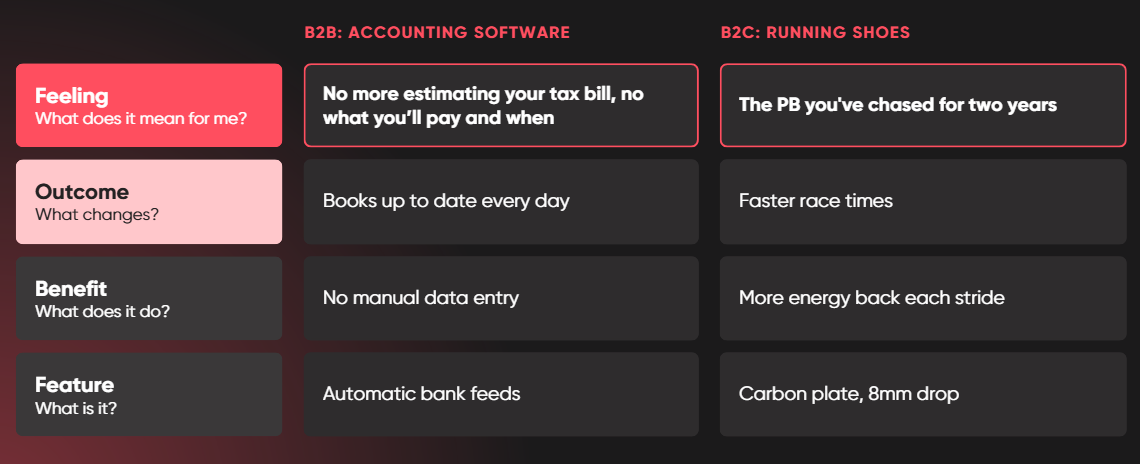
Same product, four heights. The top rung is not more emotional because it is more dramatic, it is more emotional because it is closer to the reason somebody wants the thing.
What it looks like side by side
-
Bottom rung: Our new serum contains 10% niacinamide and 2% hyaluronic acid. Dermatologist tested. Shop now.
-
Top rung: That 2pm shine you keep blotting? Made for exactly that. Then the proof: 10% niacinamide to calm oil, dermatologist tested.
-
Bottom rung: Introducing automated reporting: 40+ integrations, real-time dashboards and custom KPIs.
-
Top rung: Monday's board report, done before your first coffee. Then the proof: it pulls from 40+ tools on its own.
Nothing has been removed in either rewrite. The order changed, and the order is the whole game.
The objection
Yes, this applies to B2B, and arguably more so
The standard pushback is that B2B buyers are rational, committee-driven and immune to all of the above.
They are not, and the reason is straightforward when you say it out loud. A B2C buyer who makes a bad call has wasted 40 quid. A B2B buyer who makes a bad call has to explain it to their boss, defend it in a quarterly review, and live with it for the length of the contract.
Fear of getting it wrong. Wanting to look competent. Relief that a problem stops being yours. Those are the things sitting underneath a procurement decision, underneath the spreadsheet comparing vendors, and underneath the email that gets forwarded with 'this looks good' typed above it.
Write to the worry they will not say out loud, and give them words they can forward upward without editing. That is the whole of B2B email psychology in two sentences, and I spend a lot longer than two sentences on it elsewhere.
Try it
A ten minute exercise with your last campaign
If you have to put a model in a report, and most of us do, build it in layers and label each one for what it is.
-
Open the last email you sent. Not your best one, your last one. A representative sample beats a flattering one.
-
Find the rung your subject line is written from. Feature, benefit, outcome or feeling. Most land on rung one or two, including mine when I am in a hurry.
-
Climb it. Rewrite the subject line and the first line from the top rung, keeping everything else exactly as it is.
-
Move the specification down. Whatever you led with becomes the proof, sitting under the claim rather than in front of it.
-
Check that the subject line keeps its promise. The top rung is not permission to oversell. An opening that promises more than the body delivers costs you more than a dull one ever did.
-
Send it to half your list and compare. Clicks and replies rather than opens, since opens stopped being a reliable measure of anything in 2021.
Where the rest of this lives
The feeling ladder is one piece of a much larger picture, and the piece I find easiest to hand over in a blog post because it works on its own from the moment you read it.
The rest is harder to compress. How an email moves through the brain in the first second and where most readers leave, the five decisions your copy has to win before anybody clicks anything, why your subscribers' checking habit has very little to do with you, and the framework I use to build every email I write.
All of it sits in my Email Psychology Masterclass, which covers the human on the other end, how people decide, the psychology of copy, and what all of it changes about the way you plan a campaign.
The conclusion
Your subscribers are not reading your emails properly, and they never were. They are deciding in a second, in a kitchen, at 6am, between the kettle and the school run, and then justifying the decision afterwards if they bother justifying it at all.
Which means the job is not to explain your product better. It is to say the thing that makes somebody feel recognised in the half second you have, and keep the explanation for the people who have already decided to care.
Climb the ladder. Lead with the feeling, prove it with the feature, in that order, every time.