
Personalisation worked for about a decade, and it worked for a reason that had nothing to do with marketing.
Your own name cuts through (this is scientifically proven). Moray demonstrated it in 1959, the effect has been replicated endlessly since, and when somebody first put a merge tag in a subject line they were borrowing one of the most reliable findings in attention research.
It does not work any more (to get the impact you WANT), and the reason it stopped is the same reason it worked in the first place. Not fatigue, not creative, not a tired audience. Something fairly specific happened to the signal, and understanding it tells you exactly what to replace it with.
The decay
How a first name token went from startling to furniture
Habituation is the brain's rule for anything that repeats without consequence. When something happens again and again and nothing follows, the brain stops registering it. It is how you stop hearing your own fridge.
-
Novel. Your name in a subject line. Startling, slightly uncanny, obviously meant for you.
-
Noticed. It works. Open rates jump. Everybody copies it.
-
Repeated. Every brand, every email, with nothing behind the cue.
-
Ignored. The brain files it under noise, alongside the fridge hum and the sound of your own breathing.
What breaks habituation is consequence, not creativity. The token stopped working because the promise it made, this email is about you, was almost never kept.
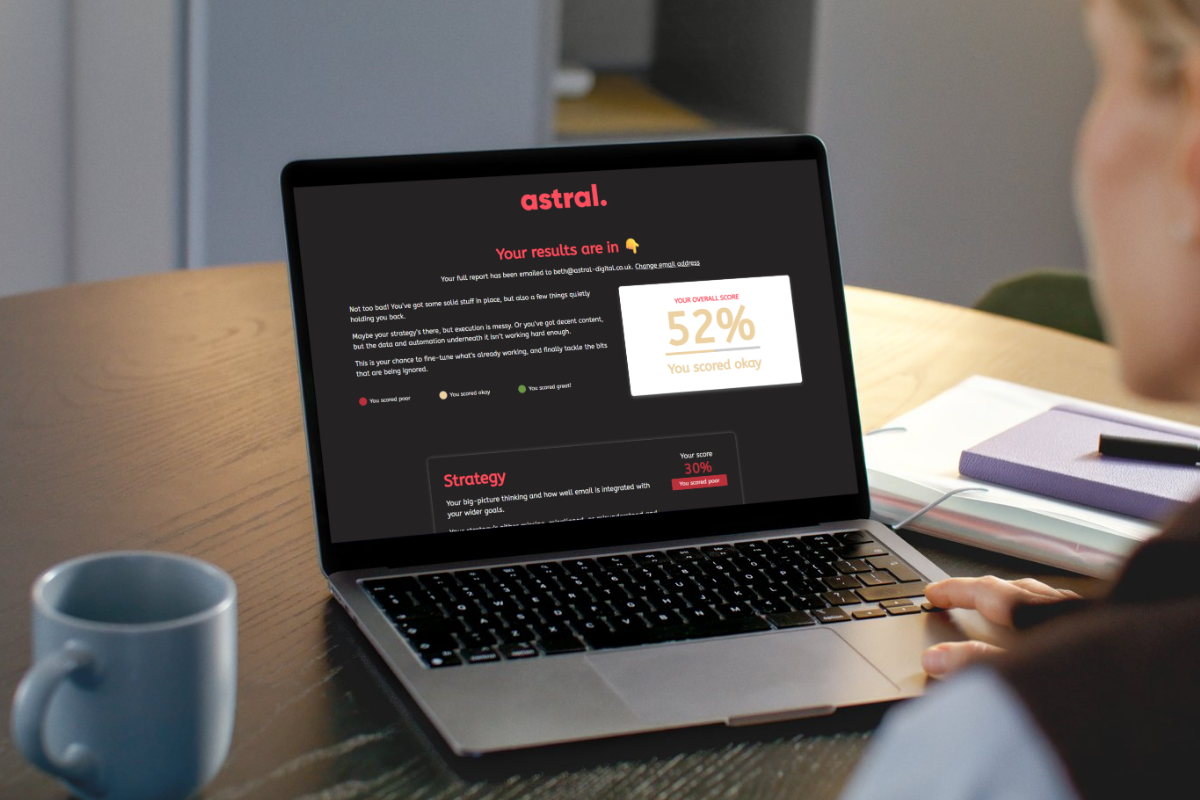
Free Email Marketing Health Check
Audit your entire ecosystem in under 30 minutes
Answer a set of straightforward questions across every area of email marketing and get a personalised score, traffic-light priorities, and clear actions and improvements you can make today.
The economics
When everyone can say your name, saying it means nothing
Costly signalling is the idea that a signal only carries meaning when it takes effort to produce. A handwritten card means more than a text message, not because the words are better, but because the effort is visible and unfakeable.
Personalisation used to be a mild version of that. Somebody set up the data, somebody maintained it, somebody chose to use it, which made it a weak but real signal that a business had bothered.
AI made that effort free. When generating a thousand individually tailored emails costs the same as generating one, the tailoring stops signalling that anybody cared, because it no longer takes any caring to produce.
A birthday card from your nan and an automated birthday email from a shoe shop can contain identical words. Nobody has ever confused the two.
The backfire
There is a line between feeling known and feeling watched
The other half of the problem is that personalisation got better at exactly the moment people got more suspicious, and the two collided.
-
Feels watched. Hi Sarah, we noticed you viewed the linen dress three times. Personal data they did not knowingly hand over, announced back at them. The threat-scanning part of the brain reacts before the thinking part gets a say.
-
Feels known. Linen creases, so here is how it looks after a full day. The same signal, used to answer the doubt they were having, without telling them they were being observed.
Researchers call it the personalisation paradox. Data people did not knowingly share makes them feel exposed, and response drops rather than rises. Aguirre and colleagues documented it in 2015, and every year since has made it more pronounced.
The replacement
Only two things reliably cut through, and personalisation bet on the wrong one
Attention in the inbox is already allocated. People arrive pointed at a task or moving on autopilot, and things only grab attention automatically when they match what somebody is already set up to look for.
-
What feels about me. Self-related information gets noticed and remembered, which is the bet personalisation made and won for a while.
-
What matches the current goal. Whatever the person is trying to do right now. B2B: today's problem or priority. B2C: their situation, rather than your catalogue.
Personalisation bet everything on the first. Intent bets on the second, and the second does not habituate, because it is not a cue, it is a match.
Personalisation guesses who they are, intent knows what they are trying to do
Which is why timing beats tailoring, every time, and why the most effective emails I see are often the plainest ones that happened to arrive on the right day.
The signals
Four kinds of intent, and most businesses already have all four
-
Explicit. They tell you. A form, a reply, a preference, a question. Direct data, freely given, and the easiest of the four to act on.
-
Behavioural. They show you. Pages browsed, products viewed, a guide downloaded, a basket left, a pricing page visited twice.
-
Contextual. The moment they are in. Onboarding, renewal, a first purchase, a quiet spell. Not something they did, something that is true about where they are.
-
Negative. They are telling you not now. An open complaint, a recent purchase, an active sales conversation. The most underused signal in email by a distance.
Most businesses hold all four and send the newsletter anyway, which is the gap between having data and having a strategy.
Every signal has a feeling underneath it
-
Downloaded a guide. They are asking: is this for someone like me? Lead with recognition.
-
Abandoned a basket or a demo form. They are asking: what if it is wrong? Lead with safety.
-
Renewal coming up. They are asking: is it still worth it? Lead with status, what they and their team achieved.
-
Just bought. They are asking: did I make the right call? Lead with hope, what happens next.
-
Gone quiet. They are saying: not now, too much. Lead with relief, and offer them less of you.
The abandoned basket is the clearest example
Think about what is going through somebody's head when they leave a basket. Is this worth it. What is the returns policy. Will it work for me. They are checking reviews, looking for codes, comparing other options, saying I will think about it and let me check with my partner.
Nothing in there says I forgot. Everything says I am not sure.
-
The reminder. You left something behind, complete your order now. Treats doubt as forgetfulness, then adds 10% off, which teaches everybody to wait for the discount next time.
-
The reassurance. Not sure it is right for you? Nothing lost if it is not. Free returns, real reviews, how it fits. Answers the feeling they had.
An abandoned basket is closer to a support ticket than a reminder, and treating it that way is worth more than any amount of merge tags.
The forecast
Where I think the inbox goes next
A prediction rather than a fact, but every signal I can see is pointing the same way.
-
Summary first, email second. Providers already summarise mail before anybody opens it, and around 55% of people make inbox decisions from the summary alone. Most people will meet your email through a summary before they ever see your design.
-
Ranked by relationship. Inboxes will increasingly sort by how much a person values you rather than when you pressed send.
-
Assistants acting on their behalf. Filing, unsubscribing, and eventually buying, without the human in the loop for every step.
-
Human becomes premium. When everything can be generated, email that feels like a person wrote it stands out more, not less.
None of which changes what happens inside a human head once they see you. The machine changed, the human did not. Same brain, same to-do list, same one thumb.
The conclusion
Personalisation did not stop working because audiences got cynical. It stopped working because it became free, and a signal that costs nothing signals nothing.
What replaced it is not a clever new tag, it is a different question. Not who is this person and what can I call them, but what are they trying to do right now and what do they need from me next.
Stop telling people you know who they are. Show them you know what they need.

Bring it to your team
I run email strategy and psychology workshops built around your list, your data and your own emails, for B2B, B2C, charities, membership bodies and SaaS. We map your signals, work out what each one is really saying, and rewrite a few of your triggered emails in the room.
Further reading from The Vault:
- Nobody Goes Into Their Inbox to Read Your Email
- Your Subscribers Do Not Decide With Logic, They Justify With It
- Email Exclusions and the Sending Hierarchy
- Show Me Your Last Ten Emails and I Will Tell You Your CRM Level
- The State of Email Deliverability in 2026