

Email marketing is not dead (I'd be out of a job for one!), it still works, and for most businesses it remains the highest-return (I have to be clear this means different things for different businesses) channel they own.
The evidence that email works is disappearing faster than the performance is. Opens are compromised, clicks are falling for structural reasons, and AI is changing what happens between your send and your subscriber.
This creates a dangerous few years. Businesses are going to look at declining numbers, conclude the channel is finished, and cut the one relationship they own outright. The numbers are telling you less than they used to, that is all!!
The symptoms
Why email open rates and click rates are falling
Four things are happening at once, and only one of them is about the quality of your email.
1. Opens stopped meaning anything in 2021
Apple's Mail Privacy Protection began pre-loading images regardless of whether anybody looked, which inflated opens for some senders and scrambled them for everybody. Your open rate has been a blend of humans and machines ever since. #
Personally, I don't CARE about my opens on astral's emails, but I care if there is a sudden jump down or up.
2. AI now reads your email before the human does
-
Summaries arrive before the email. Providers generate a summary that people read in the inbox, and around 55% say they make inbox decisions from that summary alone. Your carefully built email is being judged by a paraphrase of itself.
-
The inbox ranks you. What gets seen first is decided by how people have engaged with you before, which compounds in both directions.
-
Machines may open to summarise. Adding another layer of noise to a metric that was already noisy.
If the summary answers the question, the open never happens and the click never happens. The email worked, the report says it did not.
3. Clicking is more effort than it has ever been
A click asks somebody to stop the task they came into the inbox for, leave the inbox, load a page on a phone and then do something. Four decisions, and every one of them is a chance to stop.
4. Everybody is drowning
More content exists than at any point in history, and the cost of producing it has collapsed to roughly zero. Attention has not expanded to match. When there is too much, people do not read more carefully, they switch from evaluating to filtering, and filtering is a cheaper mental operation that catches good email alongside bad.
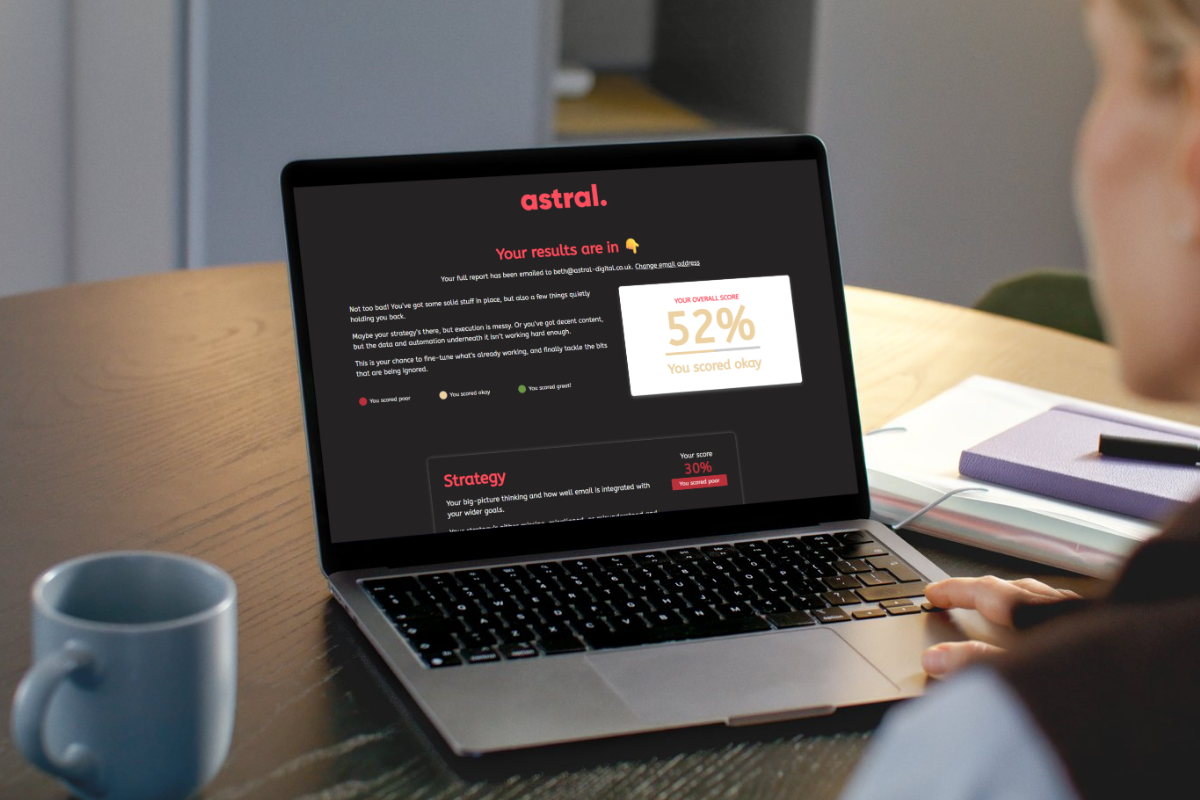
Free Email Marketing Health Check
Audit your entire ecosystem in under 30 minutes
Answer a set of straightforward questions across every area of email marketing and get a personalised score, traffic-light priorities, and clear actions and improvements you can make today.
The answer
Does email marketing still work? Yes, at the thing it was always best at
Email was never primarily a conversion channel, it was a relationship channel that happened to be measurable. The measurement is what broke.
-
It is the only audience you own. Social reach is rented, search rankings move under you, ad costs rise whenever somebody else bids. Your list is the one group you can reach without asking permission from a platform.
-
They chose you. Somebody gave you access to the place they do their admin, pay their bills and talk to their boss. Every other channel interrupts, email was invited.
-
It works unopened. Familiar things are easier for the brain to process, and ease registers as liking. Your sender name landing in an inbox is an impression whether or not anybody clicks, and over time that familiarity is what makes somebody choose you when the need arrives.
-
Most of your audience is not buying yet. In B2B, roughly 95% of your market is out of market at any moment. If every email is trying to sell, you are talking to 5% and irritating the rest. For the 95%, the job is trust.
-
And the impact lands somewhere else. People search for you afterwards, mention you to a colleague, come back a fortnight later through a different route. Email's contribution rarely shows up in a last-click report, which is a flaw in the report.
This is my reframe
It is not Customer Relationship Management; it is Audience Relationship Management
I have started calling it ARM rather than CRM, and the reason is not branding. The noun in the middle is wrong, and it changes how entire businesses behave.
Customer is inaccurate for most of the people on your list
-
Most of them have never bought anything. And a meaningful proportion never will, which does not make them worthless. It makes them an audience.
-
Plenty of organisations have no customers at all. Charities have supporters. Membership bodies have members. Publishers have readers. Universities have alumni. All of them get sold software that calls everybody a contact attached to a deal.
-
The word sets the behaviour. Call somebody a customer and you treat the relationship as a pipeline with a destination. Call them an audience and you treat it as something you are building, where attention is the thing being earned and the purchase is one possible outcome among several.
What changes when you manage an audience instead
-
You count the first conversion. Somebody joining your list is a conversion in its own right. They let you into their inbox. Most businesses never count it, then spend it immediately.
-
You value people who never buy. The person who forwards your email to the decision maker, recommends you in a Slack group, or reads you for three years before a job change makes them a buyer.
-
You ask what they came for. An audience joined for a reason. Delivering that reason is the whole deal, and most welcome programmes never mention it.
-
You measure the relationship, not the send. Because a relationship cannot be judged on one interaction, and no other relationship in your life is.
-
And selling gets easier, not harder. An audience that trusts you converts faster and complains less. The commercial case for ARM is not softer than CRM, it is slower and larger.
The measurement
What to measure when opens and clicks stop telling you anything
If the channel is a relationship builder, measure it like one. Across a quarter, not a send.
Familiarity: are people seeing you?
-
Reach and impressions. How many people saw your name this month, opened or not.
-
Search uplift after sends. Branded search tends to move after a good email, which is exposure doing its job.
-
Time until disengaged. How long before people drift. That is habituation, measured.
Trust: are they choosing you?
-
Conversion to trust: rate, strength and decay. How many chose you, how strongly they joined, and how fast that fades without reinforcement.
-
Engagement by opt-in type. A newsletter sign-up and a ticked box on a download behave nothing alike. Track the source or you cannot see the difference.
-
Replies, forwards, complaints and unsubscribes as a trend. Direction matters far more than any single month.
Assist: is it moving the business?
-
Return on impact across a quarter. What did email move. Leads, sales, renewals, retention.
-
Conversion by intent level. Are your high-intent emails helping people decide?
-
Time to action. How long from a signal to the next meaningful step.
-
Emails per conversion. Are you getting more from sending less? Usually yes.
The conclusion
Email marketing is not dead. What is dying is the illusion that two easily gamed metrics ever described what it was doing.
The channel still has the only audience you own, the only invitation you were given, and the only touchpoint that builds familiarity whether or not anybody opens it. All of that survives AI summaries, information overload and whatever arrives next, because none of it depended on an open rate in the first place.
Stop managing customers. Start managing an audience, measure what the relationship is doing over time, and the question stops being whether email still works.
None of it works if you are not landing
The fastest way to make email look dead is to stop reaching the inbox. Deliverability decline is gradual, invisible in most reporting, and easily mistaken for a channel in decline.
My free 60 minute Email Deliverability Training covers reputation, engagement signals and what normal looks like. The Email Deliverability Certification Programme takes you through the full audit process.
Further reading from The Vault:
- Nobody Goes Into Their Inbox to Read Your Email
- Conversion to Trust: The Scale Nobody Measures
- Personalisation Is Dead, and AI Killed It
- Why I Hate Email Attribution, and How to Build a Model Anyway
- Show Me Your Last Ten Emails and I Will Tell You Your CRM Level
- The State of Email Deliverability in 2026