
Two calls this week with people in the same position. New to email marketing, and working somewhere that has never done it either. No programme, no history, no templates, nobody to ask. And the same question: where do I even start?
The answer most people get is a list. Welcome series, abandoned basket, re-engagement, newsletter, win-back, birthday, post-purchase, lead nurture. All of it sensible, all of it correct, and all of it useless to somebody on their own with a day job.
Because what happens next is predictable. You try to build the whole thing, it becomes unmanageable, and you end up doing a lot of email badly rather than one thing well. Six months later nobody can say whether email works, because nothing was ever finished properly enough to find out.
So do one thing, the BIGGEST thing. And the way you find it is in the data and the audience, not in a list of tactics.
What this covers
-
Starting from the commercial priority rather than the channel.
-
Where the opportunity usually hides, in B2B and in B2C.
-
The data to look at, and the data you can ignore.
-
Sizing it, so you can defend the choice.
-
Choosing the format, because not every opportunity is a journey.
-
And turning it into email that sounds like it was written for a human.
Start with this:
What is the business trying to achieve, before you think about email at all
Email is not the starting point. The starting point is whatever the business is being measured on this year, because that is the only thing that will get your work supported, resourced and noticed.
It is nearly always commercial, whatever the organisation. A B2B business wants more qualified leads and more revenue. An ecommerce brand wants more orders and higher repeat rate. A charity wants more donations and better supporter retention. A membership body wants renewals.
-
Ask the question out loud. What is the number this business is worried about, and who is worried about it? Then work backwards to where email could move it.
-
Pick the thing somebody senior already cares about. A small win on a priority gets you budget. A large win on something nobody is measuring gets you a polite thank you.
-
And be specific about the mechanism. Not email will help with leads. Email will follow up the 4,000 enquiries a year that sales does not have time to chase.
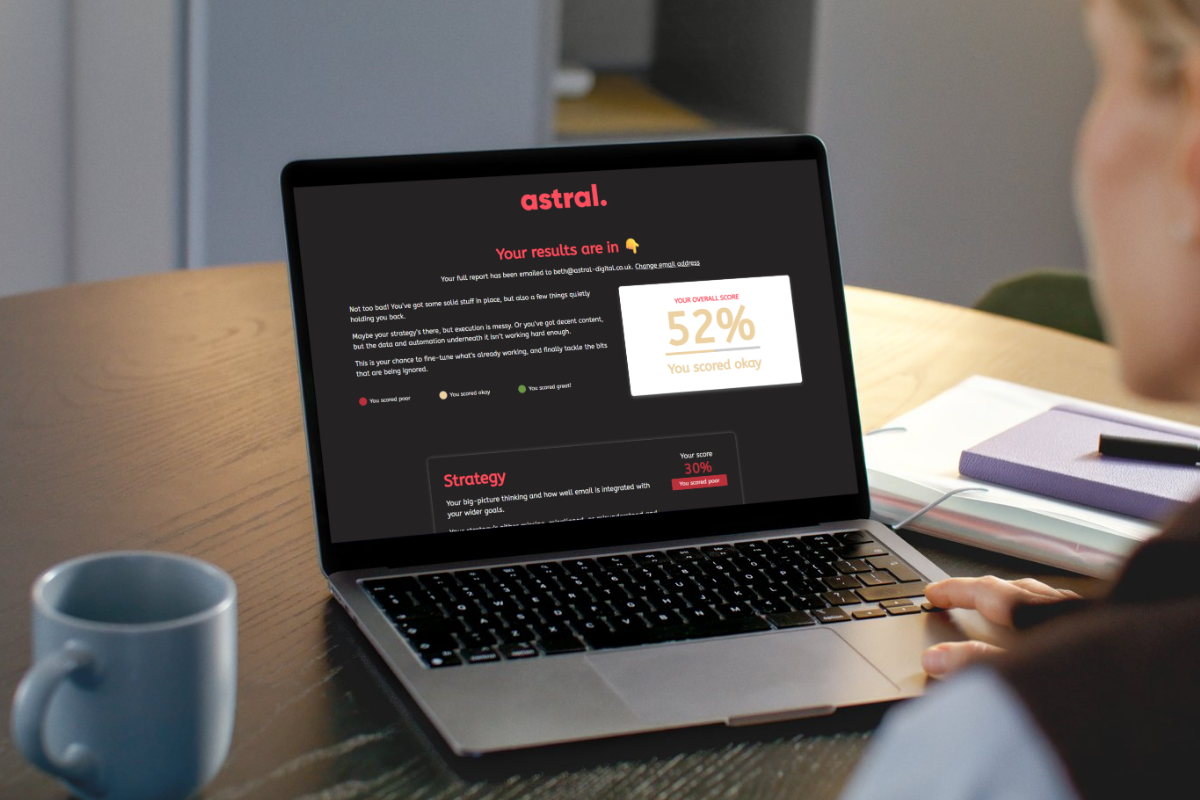
Free Email Marketing Health Check
Audit your entire ecosystem in under 30 minutes
Answer a set of straightforward questions across every area of email marketing and get a personalised score, traffic-light priorities, and clear actions and improvements you can make today.
The gap
Where the opportunity usually hides
Across every workshop I run, the biggest opportunity is almost always a group of people who raised their hand and then nothing happened. Not a new audience to go and find. People you already have, who went quiet or disengaged, because there was no process to catch them.
In B2B, the first four places I look
-
Enquiries that went cold. Somebody filled in a form, sales called twice, they did not respond, and the record has sat there for eight months. They were interested, the timing was wrong, and nothing has spoken to them since. The single most common unexploited opportunity in B2B, by a distance.
-
Lost opportunities. Deals that went to a competitor, or to nothing. Pull the lost reasons. Where the reason is timing, budget or not now, you are looking at a warm audience nobody is allowed to keep calling.
-
Upsell and cross-sell into existing customers. Who already trust you, already buy, and frequently have no idea what else you do. Cheapest revenue in the building.
-
Lead nurture before sales gets involved. In most B2B markets the overwhelming majority of your audience is not ready to buy today. If every touch is a sales call, you are talking to the small ready fraction and burning the rest.
In B2C, the first four
-
The first to second purchase gap. Usually the biggest single drop in any ecommerce business, and the most predictable. Somebody bought once and never came back.
-
Where volume arrives and leaks. Find your largest entry point, then find where those people stop. The gap between the two is your opportunity, and it is a measurable one.
-
Browse and basket behaviour nobody is responding to. People demonstrating intent and getting nothing, or getting a reminder when what they needed was reassurance.
-
Lapsed customers with a predictable cycle. If people reorder every eleven weeks and somebody is at sixteen, you do not need a campaign, you need a trigger.
The data
What to look at, and what to ignore for now
You do not need a data project for this. You need five or six numbers, and most businesses can get them in an afternoon.
What you need
-
Where people enter, and how many. Every route onto your database, with monthly volumes. Forms, purchases, events, imports, sales. Where does the volume really come from?
-
Where they stop. Your funnel or lifecycle stages with counts at each. Enquiry to qualified to proposal to won. Or visitor to first purchase to second. The biggest proportional drop is your candidate opportunity.
-
The size of the stuck group. How many people are sitting in the stage where everybody stalls, and how long have they been there?
-
What one conversion is worth. Average order value, average deal size, average donation, average lifetime value if you have it. Rough is fine.
-
The timings. How long from enquiry to purchase. How long before somebody goes cold. How long between repeat orders. Timings tell you when to send, which matters more than what you send.
-
And what you already hold about them. What fields are populated, and what is reliably populated, which is a different question. Build your first thing from data that exists.
What to ignore, for now
-
Industry benchmarks. Your own numbers are the only comparison that means anything, and you are about to create the baseline.
-
Anything requiring an integration you do not have. Note it as a future requirement and move on. The first thing you build should not depend on a project.
-
Perfect data. You are sizing an opportunity, not auditing a balance sheet. Directional is enough to choose between options.
-
And demographic segmentation. Tempting, rarely useful at this stage. What people have done tells you far more than who they are.
The sizing
Three numbers, so you can defend the choice
Before you build anything, write one line that a finance director would accept. Volume, a conservative conversion assumption, and value.
-
An example. 4,000 cold enquiries a year. A 2% recovery rate. An average deal value of £3,000. That is £240,000 of pipeline from one automated sequence, built once.
-
Be deliberately pessimistic. Use a conversion rate you would be embarrassed to miss. If the business case works at 1%, you have a very easy conversation ahead and no risk of overpromising.
-
Then compare two or three options on the same basis. Which is how you find out that the thing everybody was asking for is worth a fraction of the thing nobody had thought of.
The format
Not every opportunity is a journey, and picking wrong costs you months
Having found your opportunity, the next decision is what shape it takes. People default to building an automated journey because that is what sounds like proper email marketing, and it is frequently the wrong answer.
-
A triggered journey, where a repeatable event fires it. Somebody enquires, buys, lapses, hits a date. If the trigger happens continuously, build it once and it works forever. The highest return on effort available to you.
-
A single email, where the group is finite and sitting there now. Those 4,000 cold enquiries exist today. One good email to them this month will teach you more than three months of building a sequence, and you can automate it afterwards knowing it works.
-
A campaign, where it is time-bound. A launch, a deadline, a season. Build it as a campaign and stop pretending it is a programme.
-
A regular send, where the job is familiarity rather than conversion. If your audience needs to remember you exist for the eighteen months before they are ready, you need consistency, not automation.
-
Or a joint touchpoint with sales. An automated email that warms somebody and hands over, or that tells a salesperson when to pick up the phone. In B2B this often outperforms anything marketing can do alone, and it buys you an ally.
The audience
Now work out what to say
You have the group, the gap and the format. The thing that decides whether it works is whether the email speaks to where that person is, in their language, about their situation. Which means doing twenty minutes of thinking before you write a word.
Thinking, feeling, doing, saying
Take the moment your email arrives and write out four columns. What is this person thinking at that moment. What are they feeling. What are they doing. What would they say about it, in their own words.
-
Do it for the specific moment, not the person in general. Somebody who enquired eight months ago and heard nothing is thinking something very particular, and it is not about your product.
-
The feeling column is where your first line comes from. It is also usually the column people leave blank, which is why most emails open by talking about the sender.
-
And it works best on triggered or moment-based email. A newsletter has no single moment to anchor to, so use it where something specific has just happened.
Then climb the ladder
Anything you offer can be described at four heights. The feature, what it is. The benefit, what it does. The outcome, what changes. And the feeling, what it means for them.
-
Write the subject line and first line from the top rung. That is the part people decide on, in under two seconds.
-
Then use the feature as proof, further down. Nothing is removed. The order changes, and the order is most of the result.
And write like a person, because at this stage you can
-
Plain text from a named human beats a designed template. Especially for a first attempt at a cold group. You have no brand expectations to live up to yet, which is a real advantage.
-
One idea, one action. If you cannot say what the single next step is, the email is not finished.
-
And ask a question you want answered. Replies are the most useful thing a new programme can generate. They tell you what people care about, in their words, which is your copy for the next six months.
Then what
Measure it, prove it, and only then build the next thing
-
Set the measure before you send. One number that matters commercially. Replies, meetings booked, orders, donations. Not opens, which will tell you nothing useful and can be argued about forever.
-
Keep a holdout if the group is big enough. A slice who receive nothing, so you can prove the email caused the outcome rather than coinciding with it. Also how a new programme gets its second round of investment.
-
Report it on one page, in money. What it cost, what it returned, what you learned, what you would do next. Short enough that somebody senior reads all of it.
-
Then automate what worked. Now you are building a journey around a message you know lands, which is a very different project from guessing.
- And only then pick the second opportunity. From the list you sized at the start, which is still sitting there, now with evidence behind your judgement.
What I would not do in the first six months
-
Map the entire customer lifecycle. Satisfying, slow, and it delays the thing that would have proved email works.
-
Start a newsletter because everybody has one. Unless familiarity is the opportunity you found, in which case it is the right answer and should be the thing you do.
-
Import everything you can find. A new sending domain mailing an unvetted list is how a programme ends before it starts. Send to people who recently and knowingly gave you their details.
-
Or rebuild the templates. Nobody has ever failed at email because the template was plain.
The conclusion
Starting email marketing from nothing is not a content problem, it is a prioritisation problem. The temptation is to build everything, because everything is what the articles describe, and the result is a programme nobody can maintain and nobody can evaluate.
Find the commercial priority. Find the biggest group of people already stuck. Size it. Pick the simplest format that fits. Work out what those people are thinking and feeling at the moment you reach them, and write to that. Then prove it worked before you build anything else.
And remember what email is doing while you do all of that. It is building familiarity and relationship quietly in the background, with people who will not be ready for months. The conversion you can measure is the visible part. The reason it converted was everything they received before it.

Bring it to your team
Finding the one opportunity is most of what I do in a first workshop. Your data, your funnel, your teams in the room, and a sized shortlist by the end of the day. It works as well for a business starting from nothing as for one with fifteen years of email behind it.
Further reading from The Vault:
- How to Get Better Results From Email: The Five Things I Would Fix First
- Audience Analysis for CRM and Email
- Your Subscribers Do Not Decide With Logic, They Justify With It
- Email Exclusions and Sending Hierarchy
- Stop Reporting on Opens and Clicks. What to Measure Instead
- Intentional vs Consequential Opt-Ins